
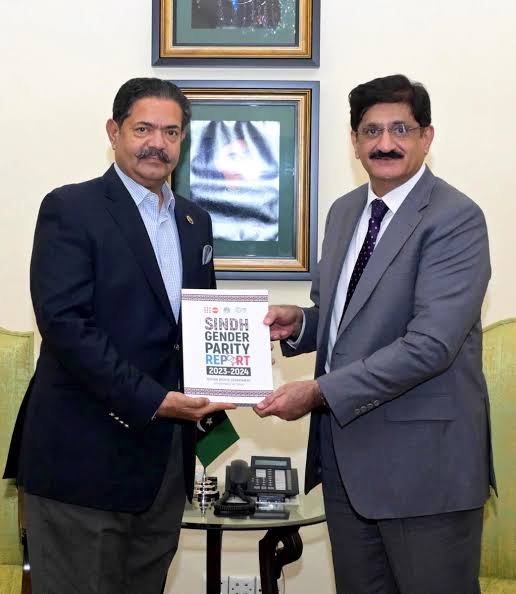
KARACHI: Sindh’s first comprehensive Gender Parity Report 2024 has been presented to Chief Minister Syed Murad Ali Shah, highlighting gender disparities across education, health, justice, employment, political participation and governance.
The report was presented by Special Assistant to the Chief Minister on Human Rights Rajveer Singh Sodho, who briefed the chief minister on key findings and indicators. The report brings together gender-disaggregated data from different sectors to support evidence-based policymaking, resource allocation and targeted reforms.
Chief Minister Syed Murad Ali Shah directed provincial departments to use the findings of the report to develop policies and measures aimed at reducing gender gaps across the province.
Major Education Gap For Women And Girls
According to the report, the literacy rate in Sindh is 68% among men and 47% among women. The situation is particularly challenging in rural areas, where female literacy stands at 27.52%.
The report also states that more than 4.08 million girls in Sindh are out of school.
The chief minister described the exclusion of millions of girls aged between 5 and 16 from education as a serious concern and called for immediate measures to improve girls’ enrolment and access to education.
He directed the relevant departments to ensure equal educational opportunities for women and girls across the province.
Maternal And Newborn Health
The report highlights a decline in maternal mortality in Sindh.
According to Rajveer Singh Sodho, maternal deaths have declined from 314 to 224 per 100,000 live births.
The report puts the neonatal mortality rate in Sindh at 24 deaths per 1,000 live births.
It also highlights the increase in Sindh’s health budget over recent years:
- 2023-24: Rs214.5 billion
- 2024-25: Rs267.54 billion
- 2025-26: Rs318.22 billion
The report identifies continued investment in healthcare as an important factor in improving health outcomes and calls for women’s healthcare needs to remain part of policy and development planning.
Women’s Representation In Police And Justice
The report also examines women’s representation in law enforcement and the justice system.
Women account for 4.34% of the Sindh Police, while their share among prosecutors stands at 18.3%.
According to the report, women constitute 13.7% of judges in Sindh.
The findings highlight the need to improve women’s representation in public institutions and strengthen access to justice and protection mechanisms.
Gender-Based Violence Remains A Concern
The report states that 3,085 cases of gender-based violence were reported in Sindh in 2024.
It identifies these cases as an area requiring continued attention to women’s safety, access to justice and protection systems.
The report calls for stronger mechanisms to protect women and improve their access to legal and institutional support.
Growth In Women’s Political Participation
The report also records progress in women’s participation in the political process.
The number of registered women voters in Sindh has exceeded 12 million.
According to the report, the number of women participating in elections increased from 23 in 2018 to 53 in 2024.
Chief Minister Murad Ali Shah stressed the importance of increasing women’s participation in decision-making and public representation.
Women’s Economic Participation
The report indicates an increase in the number of employed women in Sindh, from 2.48 million to 3.32 million.
Women’s labour-force participation also increased from 43.8% to 46.2%, according to the report.
Despite this progress, the report identifies continued barriers to women’s economic participation, including limited access to financial services, skills development, entrepreneurship and digital facilities.
The chief minister called for greater opportunities for women in skills development, financial inclusion, entrepreneurship and decent employment.
CM Directs Departments To Address Gender Gaps
Chief Minister Syed Murad Ali Shah directed provincial departments to incorporate gender considerations into their policies, development programmes and budgeting.
He called for:
- Stronger gender-disaggregated data systems
- Improved monitoring mechanisms in public institutions
- Greater coordination between government departments
- Targeted initiatives in rural and underserved districts
- Greater participation of women in decision-making
- Integration of women’s needs into development planning and budgeting
The chief minister also stressed the importance of reducing gender disparities in education, healthcare, employment and public representation.
Report Provides Evidence For Future Policy
Rajveer Singh Sodho described the Gender Parity Report as an important development for Sindh’s human rights framework.
The report brings together gender indicators from multiple sectors and provides policymakers with evidence to identify disparities, monitor progress and develop targeted interventions.
It also highlights areas requiring continued reforms and investment, particularly girls’ education, rural female literacy, institutional representation, healthcare, employment and digital access.
Key Gender Parity Indicators In Sindh
| Indicator | Reported Figure |
|---|---|
| Male literacy rate | 68% |
| Female literacy rate | 47% |
| Rural female literacy rate | 27.52% |
| Girls out of school | 4.08 million+ |
| Maternal mortality | 224 per 100,000 live births |
| Neonatal mortality | 24 per 1,000 live births |
| Women in Sindh Police | 4.34% |
| Women prosecutors | 18.3% |
| Women judges | 13.7% |
| Reported gender-based violence cases in 2024 | 3,085 |
| Registered women voters | 12 million+ |
| Female employment | 3.32 million |
| Female labour-force participation | 46.2% |
Conclusion
Sindh’s first comprehensive Gender Parity Report provides a sector-wise picture of the position of women and girls across the province. While the report identifies progress in areas such as maternal health, employment and political participation, it also highlights persistent gaps in education, institutional representation, safety and economic opportunity.
The findings are intended to provide a foundation for evidence-based policymaking, targeted reforms and improved monitoring of gender equality across Sindh.
Source: Sindh Gender Parity Report 2024 / briefing to Chief Minister Sindh.

