
Every June, the same debate resurfaces when Pakistan’s budget is unveiled: why does interest on debt get trillions while education gets billions? Budget 2026-27 is no different. Social media is flooded with one comparison: Rs8.2 trillion for interest payments versus Rs46 billion for federal education. The outrage is understandable. The numbers, however, need context.
The federal government has allocated Rs46 billion to education in 2026-27. That’s barely 0.2% of GDP. Interest servicing, at Rs8.2 trillion, consumes 46% of total federal expenditure. The contrast is stark, and it feeds the narrative that the state has abandoned human capital to service debt.
But here’s the catch: after the 18th Constitutional Amendment, education became a provincial subject. The federal budget now covers only the Higher Education Commission, federal institutions like Islamabad Model Schools, and scholarships. The bulk of spending on schools and colleges comes from provinces. When provincial education budgets are added, total public spending on education rises to Rs1.8 trillion, or roughly 1.5% of GDP.
That’s still a problem – just a different one. UNESCO recommends developing countries spend 4-6% of GDP on education. Pakistan has never come close. India spends 3.1%, China about 4%. At 1.5%, Pakistan is not only below the benchmark, it’s also below the level needed to reverse learning losses, improve teacher training, and expand access.
The HEC crisis shows what happens at the federal level. The commission requested Rs126 billion in recurring grants for 2026-27 to keep universities running. It received Rs65 billion, almost unchanged from last year. Vice chancellors have warned of salary delays, halted research, and universities operating on deficit budgets. For students and faculty, the federal allocation is not a technical detail – it’s the difference between functioning labs and closed departments.
Meanwhile, debt servicing continues to crowd out everything else. Interest payments of Rs8.2 trillion are larger than the combined federal spending on education, health, and social protection. Economists call it a debt trap: Pakistan borrows to pay interest, then borrows again next year. As SDPI’s Abid Suleri notes, without taxing agriculture, real estate, and retail, “the trust deficit between citizens and the state will widen.”
The budget expands social protection; the Benazir Income Support Programme gets Rs280 billion, up from last year, covering 12 million families. Add Rs46 billion for higher education scholarships and Rs54 billion for low-cost housing, and the government can argue it’s prioritizing the poor. Critics counter if education spending stays at 1.5% of GDP, the next generation will need BISP too.
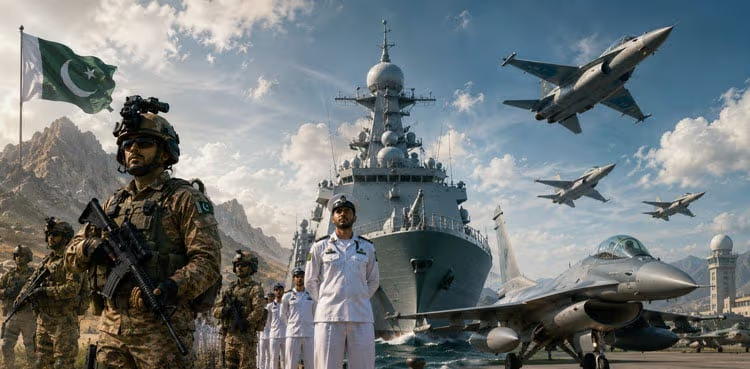
Defence spending is another point of contention. The 2026-27 allocation is Rs2.55 trillion, down from viral claims of Rs3 trillion but still 55 times the federal education budget. The state’s priority list, critics argue, reflects short-term security over long-term development. Experts are blunt about the outcome. Economist Naved Hamid calls it “an austerity budget like before”, with little room for growth under the IMF programme. Former FBR chairman Dr Irshad Ahmed says the fiscal model is trapped: “How long will they survive on loan?”
The federal government’s defence is also straightforward. Officials point to the 18th Amendment and say provinces must do more. They highlight tax relief for salaried people, a 10% hike in minimum wage to Rs40,700, and the abolition of the “pink tax” on sanitary pads. Information Minister Attaullah Tarar called it “everyone’s budget”. But the numbers suggest a structural problem. Provinces did generate a Rs1.64 trillion surpluses in FY26, which helped Islamabad meet fiscal targets. Yet repeated dependence on provincial savings, Suleri warns, “can weaken the spirit of fiscal federalism if it squeezes provincial spending on health, education, water, climate resilience and local infrastructure”.
So is Budget 2026-27 unfriendly to citizens? For salaried people in the Rs2.2m-5.6m bracket, there’s income tax relief. For BISP beneficiaries, there’s more cash. For students, teachers, and universities, the picture is bleaker. Until total education spending crosses 4% of GDP, reforms will remain cosmetic.
Right now, the budget shows a state managing liabilities, not building capacity. The 18th Amendment shifted responsibility to provinces, but it didn’t absolve the federation from setting a national priority. At 1.5% of GDP, education remains an afterthought – and no amount of debt servicing can compensate for a workforce that isn’t prepared.

