
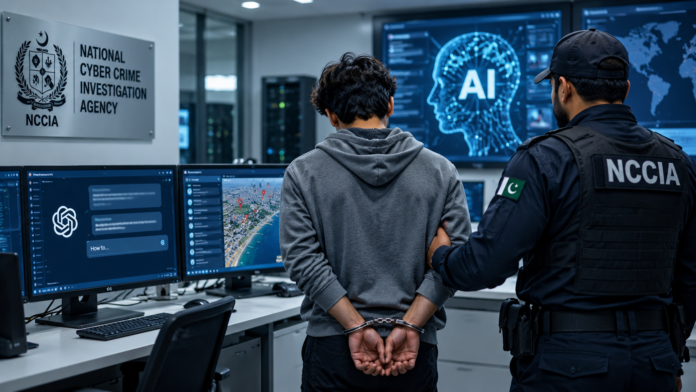
KARACHI: A 17-year-old Karachi teenager was traced by the National Cyber Crime Investigation Agency (NCCIA) after an AI chatbot flagged a series of conversations that investigators considered potentially linked to a planned killing, according to a report published by Geo News.
The case reportedly involved activity between September 1 and 4, when the chatbot flagged a conversation that breached its safety safeguards. According to investigators, the teenager had discussed a purported plan to kill the son of a police officer whom he claimed had insulted his father.
AI System Flagged Suspicious Conversation
Investigators said the teenager had discussed an alleged plan with the AI chatbot and had presented himself as being influenced by the fictional character Dexter Morgan from the television series Dexter.
The investigation reportedly began after the AI platform referred the activity through its security channels. The information was subsequently reported to the Federal Bureau of Investigation (FBI), which passed it on to Pakistani authorities, leading the NCCIA to trace the user in Karachi.
Teenager Said He Was Writing a Fictional Story
During questioning, the teenager reportedly denied having any genuine intention to commit a killing. He told investigators that he had been consulting the AI chatbot as part of work on a fictional crime story.
Investigators also questioned his father, who reportedly denied that his son was involved in any criminal activity and said the teenager spent much of his time at home watching crime dramas after attending college.
No Prosecution Reported
According to the report, the NCCIA did not establish sufficient grounds to prosecute the teenager. However, investigators reportedly remained concerned about the possibility of a real-world threat and continued to keep the teenager under observation as a precaution.
The case has drawn attention to the growing role of AI safety systems in identifying potentially harmful conversations and the way such alerts can lead to investigations when authorities believe there may be a possible real-world threat.
AI Safety and Law Enforcement
The Karachi case comes amid increased attention to the relationship between AI platforms, safety monitoring and law enforcement. It also demonstrates the difficulty of distinguishing between legitimate fictional or research-related discussions and conversations that may indicate a genuine threat.
Authorities’ interpretation of individual AI conversations remains important in such cases, particularly when no real-world offence has been established.
Key Facts
- Location: Karachi, Pakistan
- Age of suspect: 17
- Agency involved: National Cyber Crime Investigation Agency (NCCIA)
- Other agency mentioned: US Federal Bureau of Investigation (FBI)
- AI platform: Claude
- Reported activity: September 1–4, 2026
- Outcome: Teenager was questioned and reportedly not prosecuted after investigators said no offence had been established.
Frequently Asked Questions
Why was the Karachi teenager questioned by the NCCIA?
According to investigators cited by Geo News, an AI chatbot flagged conversations that appeared to contain a potentially executable plan involving a killing. The information was subsequently passed to Pakistani authorities through the FBI.
Did the teenager actually commit a murder?
No. The available report does not indicate that a murder took place or that the teenager carried one out. Investigators reportedly said they could not establish grounds for prosecution.
What did the teenager tell investigators?
He reportedly said that he had been developing a fictional crime story and had consulted the AI chatbot as part of that work.
What does the case show about AI safety?
The case illustrates how AI platforms may identify conversations that violate safety safeguards and, in some circumstances, refer potentially serious threats through established security channels. It also highlights the challenge of distinguishing fictional research from genuine harmful intent.
Source: Geo News, September 29, 2026.
Editorial note: The allegations and investigators’ interpretations in this report should not be treated as proof that the teenager intended to commit a real-world killing.

