
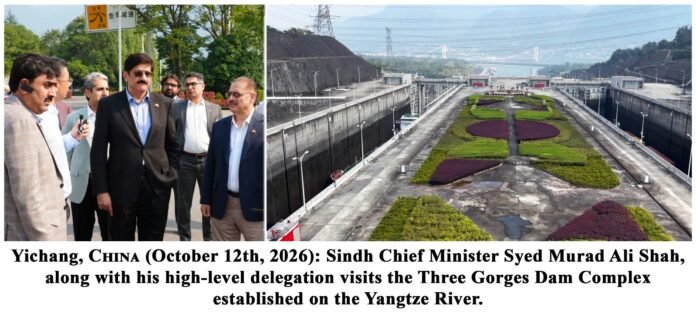
Sindh Chief Minister examines hydropower generation, reservoir management and flood forecasting systems, highlighting opportunities to strengthen water security and climate resilience in Sindh.
CHINA: Sindh Chief Minister Syed Murad Ali Shah visited China’s Three Gorges Dam during his week-long official visit, where Chinese officials and senior engineers briefed the Sindh delegation on hydropower generation, flood control, water storage and river management.
The high-level delegation accompanying the chief minister included Senior Minister Sharjeel Inam Memon, Provincial Minister for Irrigation Jam Khan Shoro, Provincial Minister for Agriculture Sardar Muhammad Bakhsh Khan Mahar, Special Assistant to the Chief Minister Syed Qasim Naveed, and senior government officials.
The visit focused on understanding China’s experience in managing large-scale water infrastructure and exploring approaches that could support Sindh’s water security, flood preparedness and long-term development.
Three Gorges Dam: Hydropower Generation and Flood Control
Chinese officials briefed the delegation on the construction and operation of the Three Gorges Dam, located on the Yangtze River, highlighting its role in electricity generation, flood control, reservoir management and inland navigation.
According to the briefing, the dam’s construction was completed in 2012. The project has an installed electricity generation capacity of 22,500 megawatts and generates more than 100 terawatt-hours of electricity annually, according to the figures presented to the delegation.
The Chinese authorities explained that the project contributes to clean energy generation while supporting flood management along the Yangtze River and facilitating inland water transportation.
Chief Minister Murad Ali Shah expressed particular interest in reservoir operations, floodwater management and real-time water monitoring systems.
Following the briefing, the Sindh delegation visited observation points at the dam and reviewed its navigation facilities. Provincial ministers also raised questions about the project’s technical and operational arrangements.
Sindh Seeks Better Water Storage and Flood Management
Chief Minister Murad Ali Shah said Sindh faces significant water management challenges due to climate change, including severe monsoon flooding and water shortages during dry periods.
He described effective water management as a strategic priority for the province, stressing the need to improve water storage capacity and strengthen preparedness for climate-related risks.
The chief minister said the Three Gorges Dam demonstrates how modern engineering, advanced technology and long-term planning can help transform water resources into drivers of economic development.
He added that modern water infrastructure could contribute to energy security, reduce flood risks and help communities adapt to the effects of climate change.
Murad Ali Shah noted that Sindh receives seasonal flows through the Indus River system but has limited capacity to store excess water. He emphasised that expanding storage capacity would be important for meeting future agricultural, urban and industrial requirements.
He stressed the need to explore innovative solutions for water conservation, flood protection and more efficient irrigation management.
Sindh to Examine China’s Water Management Model
The chief minister said the Sindh government would assess which aspects of China’s water management model could be adapted to the province’s geographical conditions and water requirements.
He directed Irrigation Minister Jam Khan Shoro and Agriculture Minister Sardar Muhammad Bakhsh Khan Mahar to examine Chinese best practices in water monitoring, smart reservoir operations and integrated river management.
The areas identified for further consideration include reservoir operations, flood forecasting, sediment management and freshwater storage.
The objective is to improve the use of available water resources, support agricultural productivity and strengthen protection for communities vulnerable to floods and droughts.
The chief minister’s remarks highlighted the importance of developing water management strategies that address both immediate challenges and the province’s long-term needs.
Protection of the Indus Delta and Coastal Environment
Murad Ali Shah also emphasised the need to protect the Indus Delta and address seawater intrusion in coastal areas of Sindh.
He said future water infrastructure projects must balance development requirements with environmental sustainability.
According to the chief minister, the ecological needs of the Indus Delta must remain an essential consideration in every water conservation strategy.
He stressed that improving water security should go hand in hand with protecting coastal ecosystems, increasing agricultural productivity and safeguarding vulnerable communities against floods and droughts.
The discussion also underscored the importance of considering downstream water requirements and environmental impacts when planning future storage and river management projects.
Sindh and China Explore Technical Cooperation
During the visit, officials from Sindh and China discussed opportunities for institutional and technical cooperation in water resource management and climate adaptation.
Chinese officials expressed their willingness to share technical expertise and experience in managing water resources and addressing climate-related challenges with Sindh.
The chief minister said his week-long official visit to China was aimed at strengthening cooperation in infrastructure development, investment, technology, education and sustainable development.
The Three Gorges Dam visit provided the Sindh delegation with an opportunity to examine modern approaches to hydropower generation, reservoir operations and integrated river management.
The experience could help inform future planning in Sindh, particularly in water conservation, flood preparedness and climate resilience. Any adaptation of the Chinese model, however, would need to account for the province’s specific water requirements, the seasonal flow of the Indus River and the ecological needs of the Indus Delta.

