
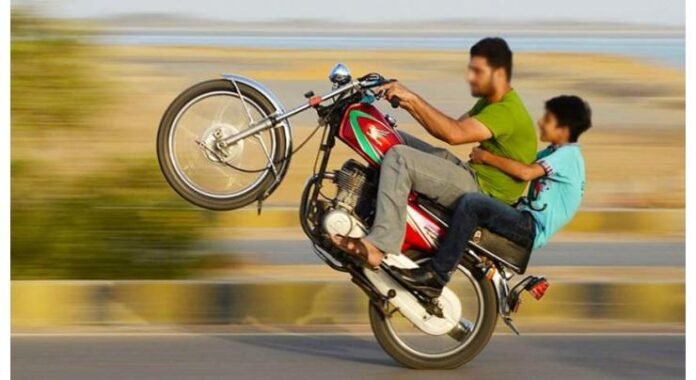
In Pakistan, the dangerous practice of one-wheeling has moved beyond occasional headlines into a grim, predictable ritual. Every week, sometimes every day, news breaks of another young life cut short on the country’s roads. What was once dismissed as youthful recklessness has now become a national crisis, claiming teenagers and young adults with alarming regularity. The recent incident in Sheikhupura is just the latest chapter in this ongoing tragedy.
On Chitti Kothi Road in Sheikhupura, 15-year-old Hamza lost control while performing a wheelie. He crashed into a shop’s glass window and died instantly. Eyewitnesses confirmed he was not wearing a helmet. A severe head injury—entirely preventable with proper safety gear—ended his life on the spot. Sadly, Hamza’s story is not unique. It is one entry in a growing catalogue of preventable deaths that has become tragically routine.
A National Epidemic
The scale of the problem is alarming. Official data from Punjab’s Emergency Services Department reveals that motorcycles are involved in approximately 72 to 77 percent of all road traffic crashes across the province. In Lahore alone, traffic accidents claimed 452 lives during 2025, with 48 people specifically injured in one-wheeling-related incidents. Across Punjab, a single 24-hour period in late 2025 saw 1,567 road crashes, claiming 26 lives and injuring 1,816 people. These are not anomalies—this is the daily toll of reckless behaviour.
A Trail of Tragedies Across Pakistan
The Sheikhupura case is far from isolated. In Karachi, a 13-year-old boy named Sylvester died near Malir Cantt after crashing into a tree while one-wheeling. In the same city, CCTV footage captured three underage boys—aged just 11 to 14—riding a motorcycle hands-free before losing control. One of them, Sajid, died of his injuries.
Lahore’s Canal Road has become a particular hotspot for such tragedies. In September 2025, two young motorcyclists, Mudasir and Subhan Sarfraz, aged between 17 and 20, lost their lives when their motorcycle collided with a car during a stunt. The Canal Road incident has been widely publicised as a warning, yet the stunts continue unabated.
In Bahawalpur, four motorcycles collided while performing one-wheeling in the DHA area, killing one person and injuring three others. In Jaranwala Road, an 18-year-old named Hasnain Ali crashed into a parked trailer while one-wheeling. In a heartbreaking twist, his own mother filed an FIR against his friends, who allegedly fled the scene instead of helping him, taking his belongings as he lay dying.
The problem extends beyond Punjab. In Peshawar, the Northern Bypass Road has become a “theatre of death” every Friday, where large numbers of teenagers gather to perform stunts, blocking traffic and endangering the public. In Turbat, Balochistan, concerned citizens report that teenagers as young as 10 to 15 gather every evening to perform one-wheeling stunts with no police presence whatsoever.
Common Threads and Demands for Action
Across all these incidents, clear patterns emerge. The victims are overwhelmingly young—often between 10 and 20 years old. Helmets are rarely worn, turning survivable accidents into fatal ones. And in most cases, there is no enforcement presence to stop the stunts before tragedy strikes. One-wheeling is already illegal in Pakistan, yet enforcement remains sporadic at best. As one citizen from Turbat noted, “With no regulatory presence, these young riders are left to endanger both themselves and bystanders without consequences.”
In response to the Sheikhupura incident, local citizens have renewed their demands for effective action: a strict crackdown on one-wheeling with motorcycle confiscation, consistent enforcement of helmet laws, and a ban on silencer-free bikes often associated with stunt culture. Parents, too, must take responsibility—knowing where their children are and what they are doing with motorcycles.
The death of 15-year-old Hamza in Sheikhupura is tragic. But it is also routine—and that is the most tragic part of all. Until society, parents, and law enforcement treat one-wheeling as the lethal danger it has proven to be, these headlines will continue to appear with numbing regularity. The question is not whether another young person will die performing a wheelie. The question is when, and where, the next one will be.

