
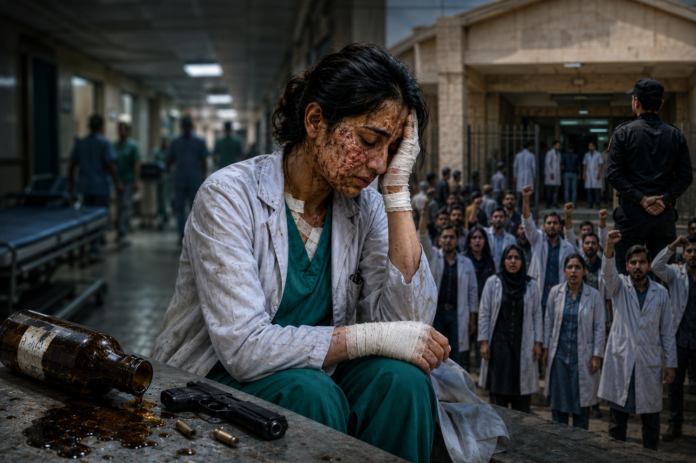
When a doctor cannot be safe inside the ward where she treats patients, the system seems to be failing twice: once to protect her, and again to uphold the basic promise of a hospital as a place of healing.
On June 6, Dr Mahnoor Nasir, a postgraduate surgeon at Quetta’s Civil Hospital, was attacked with acid by a hospital employee while on duty in the surgical ward. The assault left her with severe burns to her face, chest, legs, and other parts of her body. She was first treated at Civil Hospital, then transferred to a private facility in Quetta; later airlifted to Karachi for specialized care.
The suspect, identified as a lift operator at the hospital, allegedly knocked on Dr Mahnoor’s room door and threw acid when she came out. He escaped the scene but was later killed in a police encounter after opening fire on law enforcement. Police recovered a pistol and spent shell casings; investigations are underway.
A security failure inside the hospital
What makes this attack especially alarming is where it happened. Civil Hospital, also known as Sandeman Provincial Hospital, is one of Balochistan’s largest public medical facilities. The Young Doctors Association (YDA) Balochistan said that attack occurred between noon and 12:30pm within hospital premises and blamed ‘inadequate security arrangements’ and ‘administrative negligence’.
The YDA’s response has been swift. It condemned the attack as a serious security failure and demanded immediate government action. The association called for the suspect to be charged under anti-terrorism provisions and issued a 24-hour ultimatum: if no arrests are made, doctors would launch an indefinite boycott of medical services across the province. It also demanded comprehensive security measures for all medical staff, particularly female doctors.
Balochistan Chief Minister Sarfaraz Bugti took notice, sought a report from authorities, and directed that all possible treatment arrangements be made for Dr Mahnoor. The provincial government decided to shift her to Karachi for further treatment at government expense and said it was closely monitoring her condition.
The cost for female healthcare workers
Attacks on healthcare professionals are not new in Pakistan, but an acid attack inside a hospital ward raises distinct concerns. Female doctors in public hospitals already navigate long hours, understaffed wards, and cultural scrutiny. When the workplace itself cannot guarantee basic safety, the message is clear: staying on duty carries risks the state has not addressed.
Dr Mahnoor’s case also underscores the vulnerability of postgraduate trainees who often work in high-pressure environment with limited protection. She was on routine duty in the surgical ward when the attack occurred. Another bystander was also injured.
What needs to happen now
First, investigations must determine how a hospital employee accessed acid and entered a restricted ward. Second, the government must act on the YDA’s demands for security overhauls in all public hospitals, not just in Quetta. This includes controlled entry points, trained security personnel, and protocols for handling threats against staff. Third, there must be accountability. If administrative negligence contributed to this incident, those responsible cannot be shielded. The Home Minister has said law enforcement acted promptly after the attack. That response needs to extend to preventive measures, not just a reaction.
Finally, Dr Mahnoor’s treatment must remain the priority. The provincial’s government’s decision to transfer her to Karachi and cover costs was a necessary step. But long-term support, including rehabilitation and psychosocial care, will matter as much as emergency treatment.
Beyond one case
This is not only about Dr Mahnoor Nasir. It is about every doctor, nurse, and healthcare worker who enters a hospital expecting to do their job without fearing for their life. If hospitals cannot protect the people who work to save lives, public trust in the health system will erode further. Security for medical staff is not a favour; it is a basic obligation of the state. Balochistan’s government must act decisively; failure to do so would otherwise ensure that Dr Mahnoor’s case becomes a pattern, not an exception.
Sana Shoaib | The writer is a published author, former teacher and freelance contributor. She can be reached at sanamujahid6@gmail.com.

