
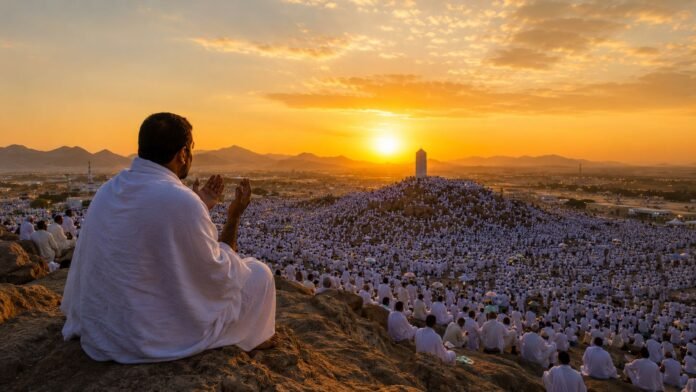
Youm a Arafah – the 9th of Dhul Hijjah – is the single most significant day in the Islamic calendar. For those on Hajj, it’s the day the pilgrimage is made. Likewise, for the rest of the Muslim world, it’s a day of mercy, forgiveness and a chance to stand in the same spiritual posture even if at home.
If you’re on the plains of Arafah, you’re living the hadith: “Hajj is Arafah.” (Reference: Sunan an-Nisa’I 3016, Jami at-Tirmidhi 889, Sunan Abu Dawud 1949, Sunan Ibn majah 3015. Classified as sahih by al-Albani.)
Wuquf e Arafah – standing on the plain of Arafah from Dhuhr on the 9th of Dhul Hijjah until Maghrib – is the core rite of Hajj. If this is missed, the rest of the rituals can’t compensate. That’s why scholars call it the rukn al-a’zami, the greatest pillar. It’s all about standing there, from Dhuhr to Maghrib, in a state of humility before Allah.
Hajj witnesses millions of pilgrims; no distinction of nationality, wealth or status. The Prophet ﷺ said that Allah boasts about the people of Arafah to the angels saying, “Look at My servants. They have come to Me, dishevelled and dusty, from every deep valley.” (Musnad Ahmad 7049 Grade: Sahih) This is the day Dua is accepted without barriers. The Prophet ﷺ said the best dua is the dua of Arafah; the best one he and the prophets before him said was: “La ilaha illallahu wahdahu la sharika lah, lahul mulku wa lahul hamdu wa huwa ala kulli shay’in qadeer”. (Tirmidhi)For the pilgrim, Arafah is where past sins are washed, future direction is set, and the soul is reset. What’s left is you and a question: what do I want to walk away with when the sun sets? Arafah gives that space to ask honestly; everything you’ve been carrying getting lighter. The crowd is massive, but the conversation is private.
It’s a day of equal opportunity for those not on Hajj. Allah didn’t restrict the mercy of Arafah to those physically present. The entire Ummah is blessed. So what it means if you’re at home: The Prophet ﷺ said fasting on the day of Arafah expiates the sins of the previous year and the coming year. [Sahih Muslim 1162] Scholars note this applies to minor sins, but it’s a massive opportunity for a spiritual clean slate. Zikr and takbir dominate the day. From Fajr on the 9th until Asr on the 13th, we enter the days of Tashreeq. The Sunnah is to keep the tongue moist with: Allahu Akbar, Allahu Akbar, Allahu Akbar, la ilaha illallah, Allahu Akbar, Allahu Akbar, wa lillahil hamd.
Dua transcends distance; you may not be at Jabal-ar-Rahmah, but the same gates of acceptance are open wherever you are. If Allah is bestowing His mercy to the people of Arafah, He doesn’t exclude those whose hearts are turned toward Him from elsewhere. Whether you’re on the plains or in your home, the notion is same: your scope of surrender. On Arafah, the pilgrim stands physically, surrounded by millions, with nowhere to hide. Off Arafah, you stand internally. No crowd, just you, your duas, and your honesty with Allah.
Both are about dropping the defences. You’re not negotiating, not justifying, not comparing yourself to others. You’re just saying: ‘Ya Rabb, here I am. I have no excuse.’ That’s why the Prophet ﷺ called it the day Allah frees the most people from the Fire. (Sahih Muslim) If you’re on Hajj guard your time, phone down, conversation minimal. Make dua for the Ummah, not just yourself. Remember: tiredness, heat and crowds are part of the test. Patience here is part of the acceptance. And if you’re not on Hajj, fast if you’re able. Make duas including yourself, family, and the Ummah. Give sadaqah, even small; the day amplifies actions.
Youm e Arafah minimizes the distance between us and Allah. For the pilgrim, it’s the climax of a lifetime journey. For everyone else, it’s a proof that mercy isn’t limited by geography. The Prophet ﷺ stood on Arafah and said, “This day I have perfected for you your religion and completed My favour upon you and have approved for you Islam as religion.” The revelation is recorded in the Holy Quran, Surah Al-Ma’idah, ayat 3 – a monumental moment in Islamic history during the Farewell Pilgrimage in the 10th year after Hijrah (632 CE). While delivering his historic Farewell Sermon on the plains of Mount Arafat, surrounded by over 100,000 companions, Prophet Muhammad (PBUH) received a revelation from Allah (SWT). This event marks the Divine completion of Islamic teachings; scholars interpret this verse as the culmination of Divine guidance. The religion was completed in a moment of collective standing, asking, and receiving.
So wherever you are on the 9th of Dhul Hijjah, stop. Stand and ask. This is the day. The gates aren’t locked for anyone who turns back.
Sana Shoaib | The writer is a published author, former teacher and a freelance contributor. She can be reached at sanamujahid6@gmail.com

