
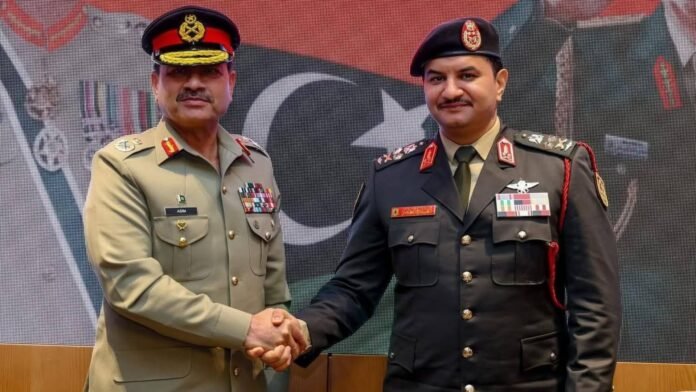
On 22 December, Reuters reported that the Libyan National Army (LNA), led by Field Marshal Khalifa Haftar, agreed to purchase major weapons systems from Pakistan in an arms package valued at over USD 4 billion.
The deal reportedly includes 16 JF-17 Thunder multirole combat aircraft and 12 Super Mushshak trainers from Pakistan Aeronautical Complex (PAC).
Other news sources have claimed that the deal also includes main battle tanks (MBT), naval systems, and training.
Neither the Pakistani government nor the Pakistani military has confirmed any of these details.
However, in November, the Pakistan Air Force (PAF) had revealed that it signed a memorandum of understanding (MoU) with a “friendly country for the procurement of the JF-17.”
Thus, there are grounds for the LNA reports, as Pakistan has an active JF-17 deal (in addition to a 40-unit sale to Azerbaijan).
Moreover, with the Bangladesh Air Force committing to the Eurofighter Typhoon, the potential pool of active JF-17 buyers is narrower – if not the LNA, it would potentially be the Iraqi Air Force.
Likewise, the reported structure of the deal – i.e., 16 aircraft – follows PAC’s recommendation for a minimum of 12 single-seat JF-17C and two dual-seat JF-17B aircraft for new customers.
Major Capability Gains for the LNA
If this news is accurate, it would amount to a significant potential boost to the LNA’s air warfare capabilities.
Recently, the LNA revealed that it inducted an unspecified number of new Tor-M2 short-range air defence systems (SHORAD) acquired from Russia, adding to a previous, but recent, reveal of Pantsir-S1 systems.
Besides air defence systems, the only other recent combat aircraft the LNA acquired were Chinese drones, which are likely used to drive intelligence, surveillance, and reconnaissance (ISR) missions.
Thus, a JF-17 squadron – especially the Block-3 – would imbue the LNA with the leading air-to-air, air-to-surface, and, potentially, electronic warfare (EW) and electronic countermeasures (ECM) capabilities in the country.
It would be a significant edge for the LNA, unless of course the GNA was to source comparable systems from its backers.
The “Look West” Thesis Strikes Again
While the arms deal has not yet been officially confirmed, Pakistan and the LNA have confirmed that they will cooperate on military matters.
Last week, Pakistan’s Chief of Defence Forces (CDF), Field Marshal Asim Munir, met with Saddam Khalifa Haftar, the deputy commander-in-chief of the LNA.
Following the meeting, Haftar announced “the launch of a new phase of strategic military cooperation with Pakistan.”
One noticeable aspect of Pakistan’s military engagement with the LNA is that it appears to diverge from that of Türkiye and Qatar – two of Pakistan’s other key partners – and from their support for the Government of National Accord (GNA), which the LNA currently opposes.
Pakistan also technically supports the GNA, though it is unclear whether that commitment remains in place given the deal with the LNA.
It would be premature to discuss why Pakistan signed a strategic military agreement with the LNA. However, the deal underscores one of Quwa’s hypotheses regarding Pakistan’s emerging foreign policy posture – i.e., taking an active interest in Middle East security issues.
If one assumes that the news about the JF-17 deal is accurate, then it will necessitate a Pakistani military presence within Libya to at least train and temporarily manage the aircraft until the LNA can fully take over.
In other words, Pakistan would involve its military personnel in yet another major security issue occurring in the Middle East.
This is basically the “Look West” thesis articulated in Quwa articles dating back to at least June 2025, starting with the first official meeting between US President Donald Trump and Field Marshal Asim Munir in the White House.

